Commission on completed rentals
Fits a platform that controls booking, payment, and supplier settlement.
The operator must explain deposits, adjustments, refunds, disputes, and off-platform leakage.
FULLY CUSTOM NEXT.JS BUILD
Directorism designs and builds the complete renter, owner, staff, booking, handoff, inspection, money, and operator experience as one custom Next.js platform you own.
For multi-owner, multi-location, specialist, or B2B rental models where a shared calendar cannot carry the operating risk.
Relevant rental delivery is shown below alongside clearly labelled conceptual deposit and availability capability.
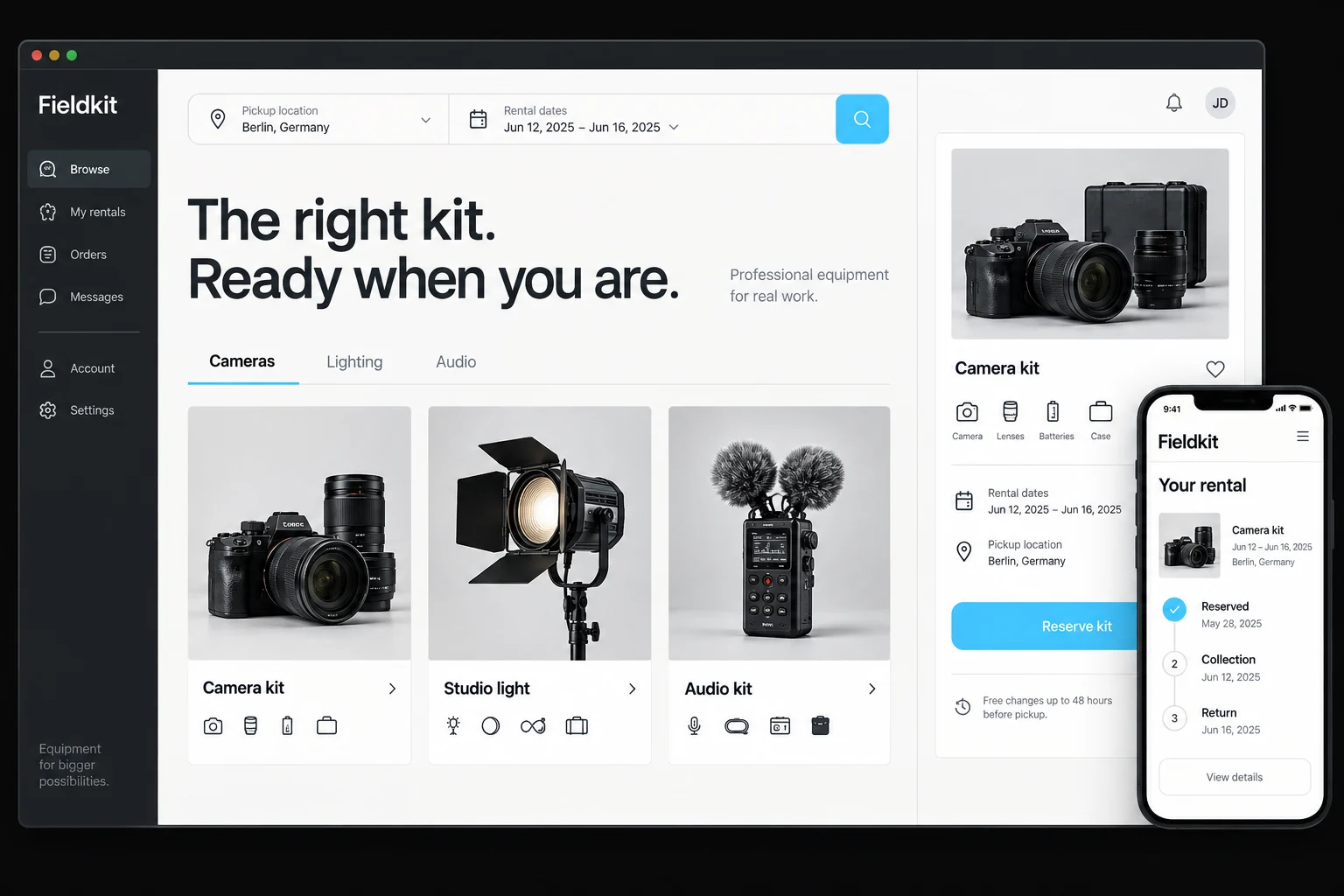
FROM RESERVATION TO RETURN
We can connect the reservation, collection evidence and return inspection in one rental record. Explore how the controls change at each handoff.
Illustrative rental workspace
One kit. Every item accounted for before pickup.
A concept for the rental controls we can design around your assets.
One asset record should tell the renter what can be promised and tell staff what must happen before the asset can be promised again.
01
Is the exact asset ready at the promised place?
Location, maintenance, blackout, and lead-time rules
02
How long is inventory protected while a buyer decides?
Quote expiry, approval, account, and reservation rules
03
What evidence makes the handoff complete?
Documents, condition, accessories, identity, and delivery
04
Can the renter extend without creating an overlap?
Extension, usage, incident, support, and replacement logic
05
Who records condition and resolves a difference?
Return time, inspection, evidence, charges, and dispute state
06
When is the asset genuinely safe to sell again?
Maintenance, deposit release, owner balance, and availability
RENTAL WORK WITH CLEAR LIMITS
The examples begin with anonymized rental delivery. Conceptual capability is labelled separately.
This evidence supports rental workflow reasoning and implementation capability. It does not imply that every equipment category, fleet integration, or logistics model has already been delivered.
Named work, anonymized delivery, and conceptual capability examples are labelled separately. Each supports only the claim stated here.
TWO FAILURES TO DESIGN OUT
We model the commercial promise and the physical operation together, then expose the next safe action to each role.
Risk 01
Maintenance, transport, preparation, another location, or an unclosed return can make apparent inventory unavailable.
Risk 02
Condition, charges, deposit release, owner settlement, and availability still need an agreed resolution path.
RETURN RESOLUTION LEDGER
Inspection is where physical condition, money, owner trust, renter support, and future availability meet.
Asset, accessories, fuel or charge, meter, documents
Return time, location, collection, grace and delay rules
Condition evidence, damage, cleaning, consumables, maintenance
Deposit, authorisation, owner balance, fees, refund or dispute
Release, repair hold, replacement or adjusted availability
START WITH CONTROL, THEN ADD BREADTH
A focused launch creates enough operating evidence to decide which asset categories, owners, and geographies should come next.
01
Your team controls inventory quality, preparation, and handoff in one market.
Can wait: Multi-owner payouts and broad geography can wait until the operating loop is reliable.
02
A small number of professional owners provide dependable inventory in one category.
Can wait: Open self-serve supply can wait until listing and condition standards are proven.
03
Buyers need specifications, account terms, transport, and human approval before commitment.
Can wait: Instant checkout can wait if the real first transaction is a qualified rental order.
UTILISATION & REVENUE
Rental economics depend on asset utilisation, handoff cost, damage risk, and who owns the customer. Healthy supply sees completed, recoverable cycles—not merely more enquiries.
INVESTMENT & FIT
Our current marketplace tiers are MVP from $18,000; larger scopes from $40,000 and from $85,000. These are starting points rather than a pre-packed rental product.
The marketplace MVP tier currently lists 8-10 weeks; larger tiers list 12-16 weeks for Scale and 16-24 weeks for Enterprise. Final investment and schedule depend on the roles, workflows, integrations, migration, and operational exceptions in your proposal.
Plan My Equipment Rental MarketplaceFully custom Next.js engagement
New platform or complete reconstruction
For founders launching a new multi-owner or specialist rental marketplace, or completely reconstructing an existing operation whose availability and handoff rules have outgrown disconnected software.
Roles, money movement, fulfilment, integrations, and operator controls need product-level ownership across several connected workflows.
WordPress can be practical for a simple rental catalogue or a small operation using a maintained booking plugin. A custom build becomes worth comparing when several connected workflows change live inventory, quotes, owner roles, deposits, logistics, inspection, or disputes.
Once three or four connected workflows need custom behaviour, a custom platform often becomes the stronger cost and ownership comparison than extending a plugin stack.
Explore WordPress servicesWe can plan the data, workflow, SEO, and operational transition as a complete reconstruction.
THE DIRECTORISM FRAMEWORK
We use maintained patterns where they fit, then design the asset lifecycle, transaction, operating controls, and integrations around your rental business.
Designed around your business
Maintained engineering patterns
Your proposal states what is included. The Framework is our delivery method, not software you license or configure.
DONE-FOR-YOU DELIVERY
We turn real yard, warehouse, owner, and renter work into an application your team can operate after handover.
What only you can decide or provide
What Directorism leads and delivers in scope
An agreed custom Next.js rental platform with one asset record connecting the promise, handoff, return, money, and next availability.
FAQ
Direct answers on marketplace models, launch focus, investment, integrations, timing, and operating ownership.
Share the first equipment category, supply, geography, handoff model, and operating constraints. We will identify the asset states, money controls, and recovery work the first scope must own.